Live Dealer Tables, Roulette Game
A practical guide to live dealer tables for roulette game: the steps, the limits and the common mistakes.
What is Live Dealer Tables?
Live dealer tables bring the atmosphere of a brick-and-mortar casino directly to your screen by streaming a real croupier, a physical roulette wheel, and genuine casino equipment in high-definition video from a purpose-built studio or a land-based gaming floor. Unlike standard online roulette, where a random-number generator (RNG) determines every outcome invisibly, a live dealer game lets you watch the ball spin and drop in real time, confirming the result with your own eyes before any payout is calculated.
In India, live dealer roulette has grown rapidly because it resolves the two biggest doubts players traditionally hold about online gambling: whether the game is fair, and whether the social dimension of a casino can survive a phone or laptop screen. Because the wheel is physical and the croupier is human, neither concern applies in the same way it does to a purely software-driven game.
Most live dealer suites offer several roulette variants from a single lobby. European Roulette, a single-zero wheel, is the most common starting point for Indian players because its house edge of 2.70 per cent is roughly half that of the American double-zero wheel. Lightning Roulette, Immersive Roulette, and Speed Roulette are enhanced versions that add multipliers, cinematic camera angles, or a faster spin cadence respectively, while Salon Privé tables cap access to higher-stakes players who prefer a quieter, more exclusive environment.
How Live Dealer Tables Works
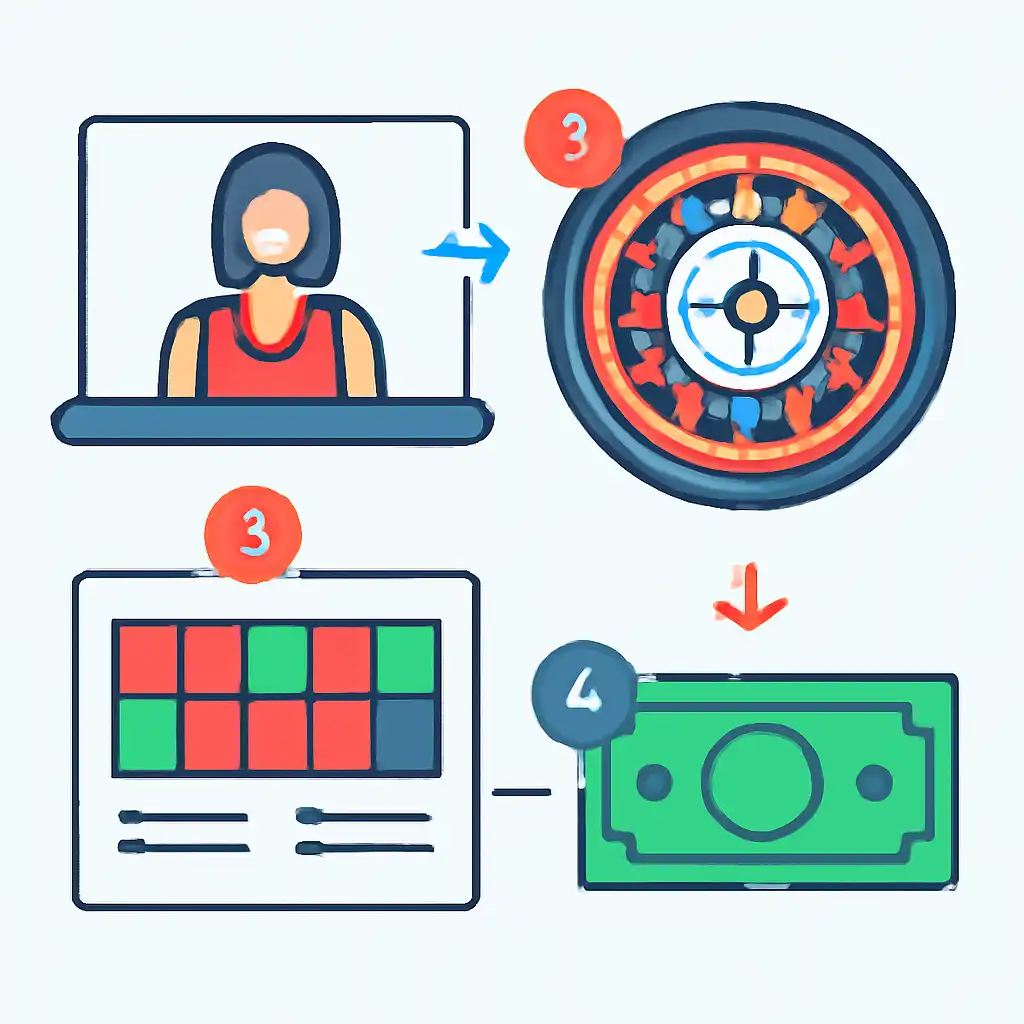
The process begins in a studio equipped with multiple fixed and roaming cameras. The croupier announces the start of each round, a countdown timer opens the betting window, typically 15 to 30 seconds, and players place chips on a digital felt overlay that mirrors the positions of a standard roulette layout. The croupier then spins the wheel, releases the ball, and calls "no more bets" before the ball loses momentum. Optical character recognition (OCR) technology reads the winning number from sensors embedded in the wheel and transmits that result to the game server in milliseconds. Payouts are credited automatically based on the registered bet positions.

Behind the scenes, a game control unit (GCU), a device roughly the size of a shoebox attached to each table, encodes the video feed and handles the OCR data link. Without the GCU the live stream cannot function, which is why reputable operators carry redundant units. The video itself travels over a dedicated fibre connection rather than the public internet, keeping latency low enough that the gap between the ball settling and your screen updating is typically under one second on a stable 4G or broadband connection in India.
All licensed live studios are audited by independent testing houses such as eCOGRA, iTech Labs, or GLI. Those bodies examine the physical wheel for bias, verify that the OCR reads correctly, and confirm that the random shuffle used in any side games meets statistical standards. Audit certificates are published by the testing house directly on their own websites, eCOGRA at ecogra.org, iTech Labs at itechlabs.com, so you can read the reports there rather than relying on any third-party summary.
Chat functionality lets you type messages to the croupier during the game. In studios catering specifically to Indian players you will often find dealers who speak Hindi or Tamil and who acknowledge players by name, recreating much of the interpersonal texture that draws people to physical casinos.
Live Dealer Tables Tips and FAQs
Choose European over American Roulette whenever possible. The single zero reduces the house edge from 5.26 per cent to 2.70 per cent. Over a long session the difference in expected loss is substantial. If the lobby offers French Roulette with the La Partage rule, which returns half your even-money stake when the ball lands on zero, the edge falls further to 1.35 per cent, the lowest available in standard roulette.
Set a session budget before the stream loads. Live tables move faster than many players expect; rounds can complete in under 60 seconds on Speed Roulette variants. Deciding in advance how much you are prepared to risk in a single session, and closing the game once you reach that figure, is the single most effective discipline available to any roulette player.
Understand that no betting system overcomes the house edge. Martingale, Fibonacci, and D'Alembert progressions redistribute losses across a session rather than eliminating them. Table maximum limits, which every live dealer game imposes, prevent indefinite doubling, so a long enough losing run still ends in a loss regardless of the system in use.
Test connection quality before wagering real money. Most live casino platforms allow you to observe a table as a spectator without committing chips. Use that mode to confirm your stream is stable; a dropped connection mid-round can cause a bet to be registered without you seeing the result, which creates confusion when you return to the session.
Frequently asked questions
Is the wheel genuinely random, or can it be manipulated? Licensed studios use certified physical wheels that are inspected and replaced on a schedule. Wheel bias, the tendency of a worn wheel to favour certain sectors, is identified and corrected before it can be exploited. The GCU's OCR reporting creates a timestamped log of every result, which regulators can audit retroactively.
Can I play live dealer roulette on a mobile phone? Yes. Most modern live casino platforms run inside a mobile browser without requiring a separate application. A screen width of at least 360 pixels renders the betting grid legibly; anything narrower may require the platform's dedicated app for a comfortable experience.
What happens if the stream cuts out while my bet is active? Reputable operators record every round server-side. If a disconnection is confirmed on your account during a round, the result is applied to your bet once the connection is restored and your balance is adjusted accordingly. The specific policy, including how long a claim window lasts, is stated in each operator's terms and conditions.
Are tips to the croupier possible in an online live game? Some platforms include a tip button in the interface. Where it exists, the gratuity is a small fixed denomination transferred directly to the dealer pool. It is entirely optional and has no effect on how the game is conducted.
Live Dealer Tables for New Players
If you have never played roulette in any format, the live dealer environment is worth approaching in stages. Begin by spending a few rounds as an observer. Every major live casino platform allows spectators to watch an active table without placing bets, and this window costs nothing. Watch how the croupier manages the countdown, note the layout positions for the bets you are most interested in, straight-up single numbers, red/black, odd/even, and get a feel for the pace before your first chip goes down.
When you are ready to bet, start on a standard European Roulette table rather than on Lightning Roulette or any multiplier variant. The base game has a straightforward payout structure: a straight-up number pays 35 to 1, a split between two adjacent numbers pays 17 to 1, and even-money bets such as red/black pay 1 to 1. Multiplier variants add a layer of volatility that is better appreciated once the fundamentals are familiar.

New player welcome offers at licensed operators often include a matched deposit bonus or free-bet credit. Read the wagering requirements carefully before accepting. A bonus with a 40× wagering requirement on roulette means you must place bets totalling 40 times the bonus amount before any derived winnings can be withdrawn. Some operators exclude live dealer games from bonus wagering entirely, which is stated in the bonus terms, check this before assuming the offer applies to live tables.
Indian players who are new to the regulatory landscape should verify that any platform they register on holds a licence from a recognised authority, the Malta Gaming Authority (MGA), the UK Gambling Commission, or Curaçao eGaming are the most commonly encountered for platforms accessible from India. Licence details are published on those regulatory bodies' own websites, where you can confirm a licence number is current and in good standing. Checking the regulator's public register directly, rather than relying on a logo displayed on a casino site, is a straightforward step that significantly reduces the risk of playing on an unlicensed platform.
Finally, every responsible operator provides access to deposit limits, session time reminders, and self-exclusion tools within the account settings area. Configuring a daily or weekly deposit limit at the point of registration, before the excitement of the first session, is the most practical safeguard available to any new player, and it takes under a minute to put in place.